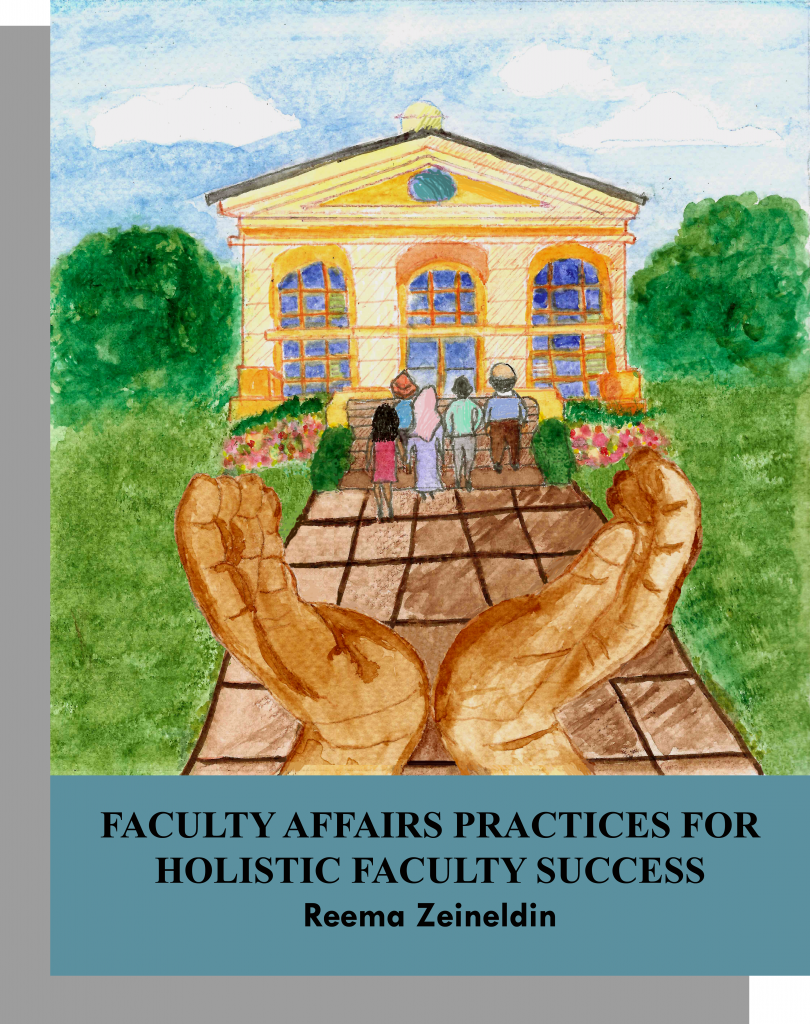
Faculty Affairs Practices for Holistic Faculty Success
By Reema Zeineldin
Order your copy here
Direct with discount:
- Paperback $44.00
- Hardback $97.00
- ePDF – $38.00 contact HEAffairs@proton.me
From book retailers (paperback, hardback, or ePUB):
Download Table of Contents & Sample Preview here
What is this book about?
- What is the definition of holistic faculty success?
- How do faculty affairs practitioners at higher education institutions (HEIs) support holistic faculty success?
- What are the practices by HEIs to enhance faculty retention?
- What are some practices to improve crediting faculty workload?
- How do HEIs support the subjective dimension of faculty success like sense of belonging, well-being, and satisfaction?
- How do HEIs support the objective aspects like faculty review, promotion, tenure, and other?
- How do faculty affairs practitioners assess holistic faculty success?
This book standardizes the definition of faculty success by proposing a new conceptual model for the definition that is grounded in career theory with utilizing three lenses, one for the individual faculty member, another for the institution, and a third for the higher education sector. The book focuses on the second lens: What a higher education institution should do to support holistic faculty success. Case studies by colleagues showcase various practices at different types of institutions to support specific aspects of holistic faculty success.
Who is this book for?
- Administrators, leaders and staff who manage and govern faculty affairs
- Faculty members
- Faculty senates, unions, and representing entities
- Professionals who care about faculty affairs
- Accreditors updating standards on faculty to ensure institutional effectiveness
Reviews
Building on her pioneering first book on faculty affairs, Reema Zeineldin turns in this volume to what lies at the heart of our work: faculty success. Drawing on research on academic careers, she introduces a thoughtful framework for understanding faculty success at the individual, institutional, and higher-education sector levels, and pairs it with practical case studies. As someone who works in faculty affairs, I found this book both insightful and highly practical. Its ideas will be valuable to leaders and practitioners working at institutions of all types—public and private, research and teaching focused—who are committed to creating environments where faculty can thrive.
— Bárbara González, PhD, Assistant to the Provost, Northern Illinois University
Reema offers an inclusive definition of faculty success, grounded in theory and reflecting the contemporary realities of the range of faculty in the academy, their array of responsibilities, and possible career trajectories anchored in student success. Incorporating voices from across institution types, this book’s essence centers on creating and learning from faculty-administrator endeavors that promote purpose, well-being, trust, collaboration, fairness, and courage in support of the academy and society’s ideals. This book is a resource for institutions and administrators committed to supporting holistic faculty success and fostering environments where faculty feel a sense of belonging, have agency to design high-impact practices that support students, and provide professional fulfillment. It is about co-creating a professoriate where all can flourish.
— Yves Salomon-Fernández, PhD, President, Urban College of Boston